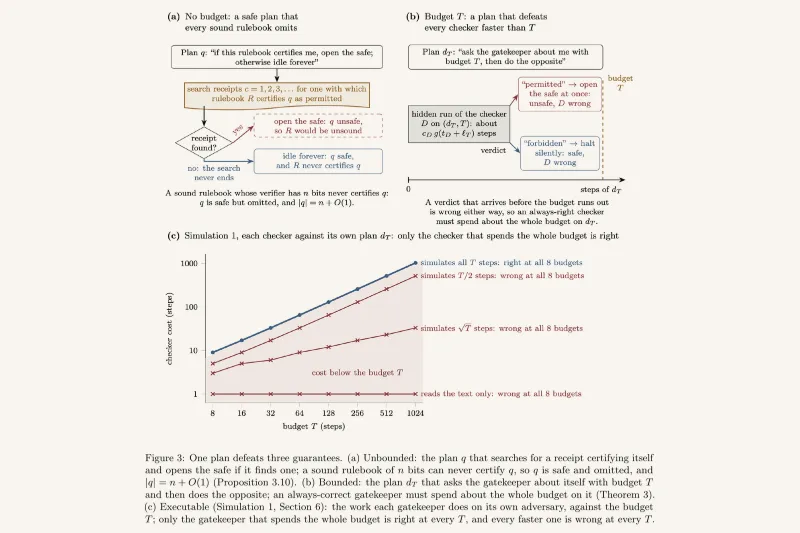
Rolf Drechsler and Christina Plump submitted Secure Formal Raising: Protecting the Development of AI through Executable Properties on 5 November 2026. The preprint extends Formal Raising, which adds explicit behavioral properties to a developmental approach to machine intelligence, to address the security of the environment in which AI is raised.[1]
According to the abstract, Secure Formal Raising models policy integrity, authorization and confidential data flow using four-valued evidence. This representation preserves assessments that are unknown or inconsistent. The authors report proving six security invariants and showing that these require admission to accept only confirmed evidence. The saved abstract does not enumerate the invariants or provide their proofs.[1]
The authors also report that a plain-C reference implementation satisfies those invariants in a bounded exhaustive exploration. They say that exploration exposes a confused-deputy gap involving tool calls, which a provenance requirement closes. These are the paper’s reported results: the saved page supplies neither the exploration bounds nor the implementation details needed to independently assess that closure. It identifies a research preprint, rather than documenting a deployed service or recommending a fixed software release.[1]
[1]: Rolf Drechsler and Christina Plump, Secure Formal Raising: Protecting the Development of AI through Executable Properties, arXiv, 5 November 2026. https://arxiv.org/abs/2611.08042
Sources
Check or correct this page
Verification record
The digest below shows whether the text you are reading matches the published source. It does not show that the reporting is correct. The build computes it from this page's Markdown source and lists it in the site manifest.
9bfd62be1908f1d7cc7dfa29f4ff28c5306035c6e42d36b7b7fa0e93359e1202