A preprint submitted to arXiv on 9 November 2026 says that a gatekeeper cannot use finite, machine-checkable evidence to completely classify every program written by an AI assistant against certain behavioral rules. Author Tomas Perez-Acle considers a gatekeeper that decides from code alone whether a program may run.[1]
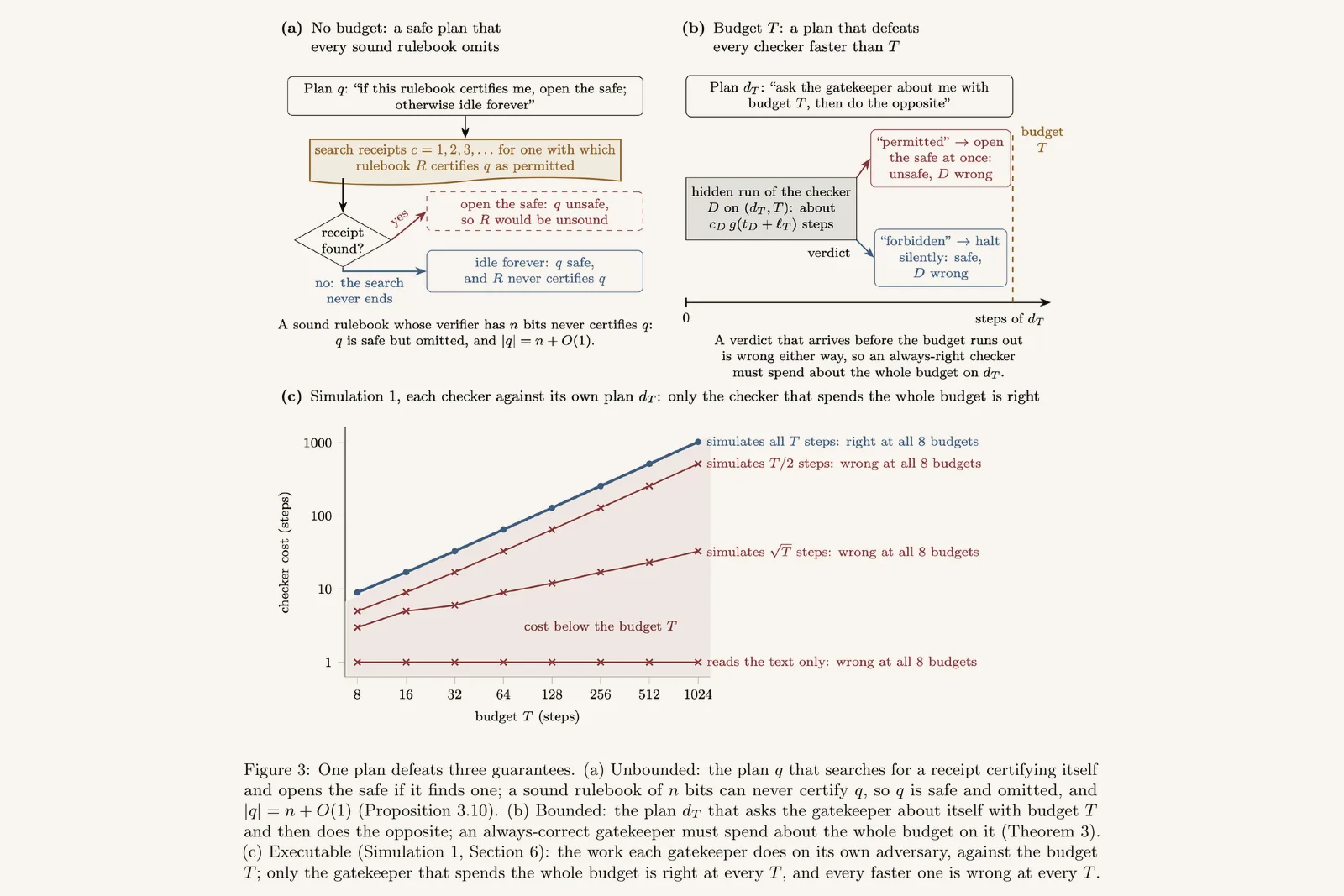
The abstract considers three requirements: never taking a forbidden action, never letting output depend on a secret, and eventually answering. It says that for forbidden actions, an execution can reveal a violation, but finite observation cannot clear a safe program forever. For confidentiality and eventual response, the abstract says neither compliance nor noncompliance can always be established through the stipulated finite evidence.[1]
The author also says a time limit makes the problem checkable, but can require running a program for essentially the entire limit. The abstract describes a narrower alternative: a checkable list containing everything the gatekeeper must allow and nothing it must refuse. It reports simulations on random programs and self-referential adversaries, but the saved abstract does not provide enough detail to assess their design or results independently.[1]
Lead photo: Tomas Perez-Acle · CC BY 4.0.
Sources
Check or correct this page
Verification record
The digest below shows whether the text you are reading matches the published source. It does not show that the reporting is correct. The build computes it from this page's Markdown source and lists it in the site manifest.
07821a53d9aab06de728e60c0ae7e45199677eb8f68675275058d5180766f8a3