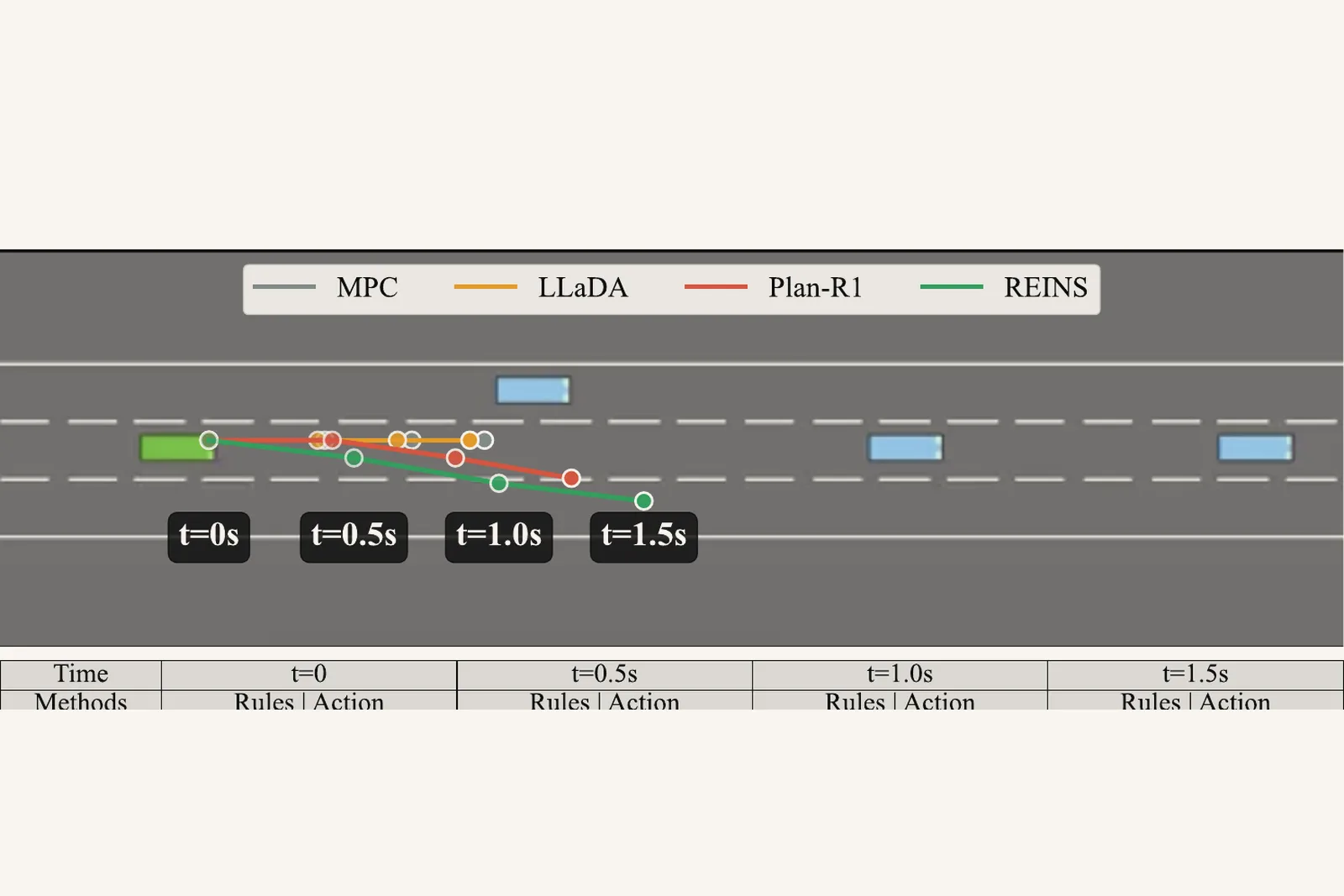
Zhihong Cui and five co-authors submitted REINS on 7 November 2026, proposing a runtime harness that lets a large language model (LLM) contribute to trajectory planning while accumulated rules handle familiar scenes. The saved arXiv page identifies the submission as version v1; this is a research proposal with author-reported results.[1]
The authors describe three connections between the LLM and planner: grounding proposals in a learned variable-level dynamics model, checking them with calibrated predicates and forward rollout, and consolidating accepted outputs into indexed rule memory. Familiar scenes use memory lookup; novel scenes invoke the LLM, whose checked outputs add to that memory. The abstract states that lookup takes O(log n) time and that the process leaves LLM weights unchanged.[1]
The authors report more than 98% compliance, nearly 50% collision reduction, and latency of 1.9–4.6 milliseconds on simulated and real-world benchmarks at the tactical decision layer. They also report that LLM invocation declines monotonically as memory matures. The saved abstract does not specify the compliance definition, collision comparison baseline, or latency measurement boundaries, so those figures cannot establish performance for a reader’s deployment.[1]
[1]: REINS: A Self-Evolving Agent Harness for Real-Time Trajectory Planning. arXiv, 7 November 2026. https://arxiv.org/abs/2611.10748
Lead photo: Zhihong Cui, Hengyu Liu, Haoran Tang, Shijun Liu, Amir Taherkordi, Tor Skeie · CC BY 4.0.
Sources
Check or correct this page
Verification record
The digest below shows whether the text you are reading matches the published source. It does not show that the reporting is correct. The build computes it from this page's Markdown source and lists it in the site manifest.
79554eabdf71cae3715150f2fc6cd266d803a566ba881bd1bb3515fc52c47bda