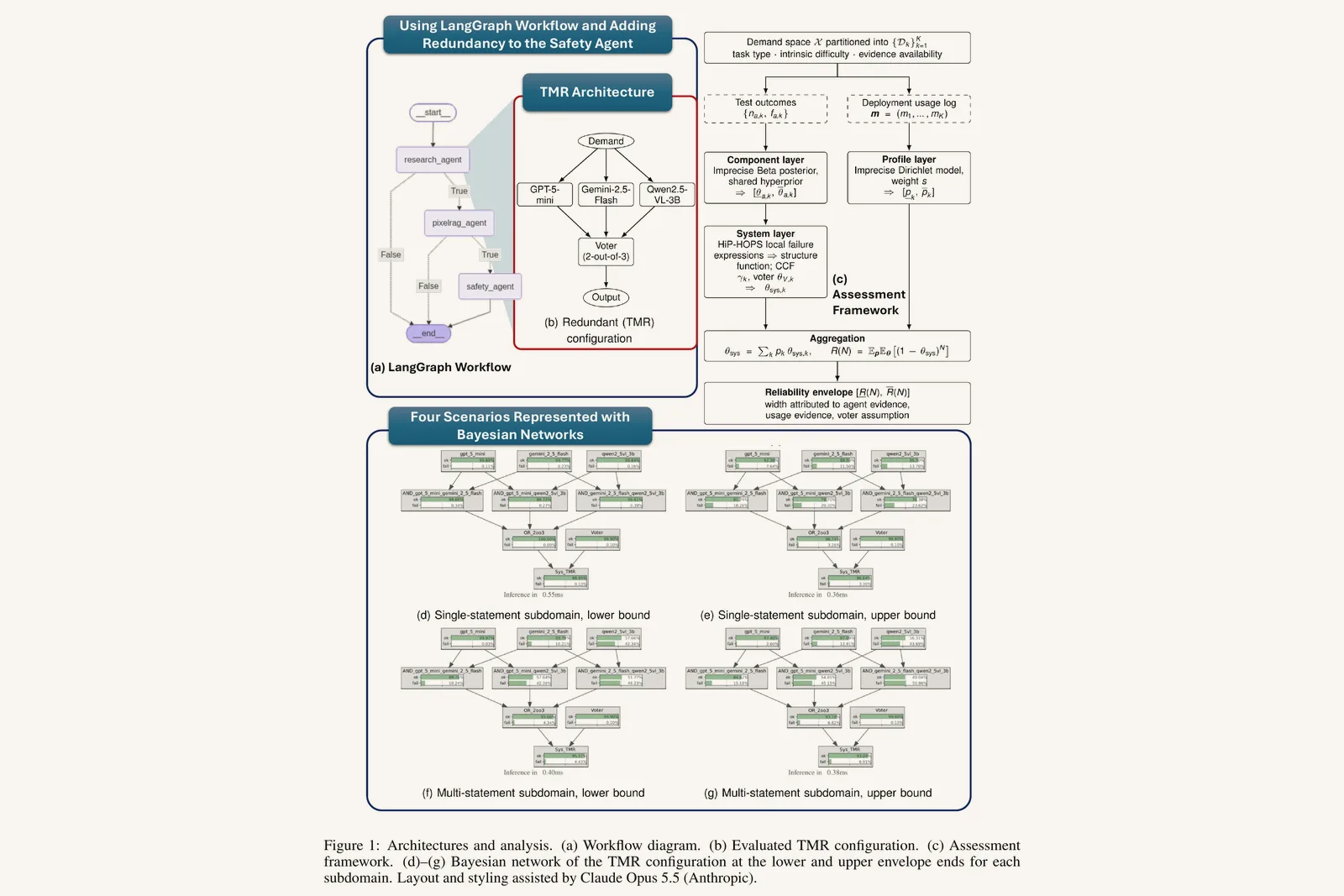
Burkay Tunçtürk, Koorosh Aslansefat, Yiannis Papadopoulos and Bao Nguyen submitted a preprint on 4 November 2026 examining whether cooperating large language model (LLM) agents make a system more reliable. The authors argue that average benchmark accuracy leaves out two consequential factors: the input mix encountered in deployment and the rule used to combine agents’ answers.[1]
Their proposed framework builds on HIP-LLM, described as a hierarchical imprecise-probability assessment of individual LLMs, and combines it with a Bayesian network representing system failure logic. Intervals for agent failure probabilities propagate through that network to produce a reliability envelope. The combining rule can also fail, allowing the assessment to account for an unreliable aggregation step.[1]
In a pipeline extracting regulated chemical-hazard statements, the abstract reports that majority voting across three models protected against the weakest model but did not clearly exceed the best. It also reports that a voter failing on 5% of demands would largely erase the advantage over the middle model. That conditional result should not be read as an observed 5% failure rate in a deployed service. The listing describes the manuscript as submitted for IEEE Software Magazine; it does not establish acceptance.[1]
[1]: arXiv, “More Agents, More Reliable? System-Level Reliability of Multi-Agent LLMs under Operational-Profile Uncertainty,” submitted 4 November 2026. https://arxiv.org/abs/2611.07140
Lead photo: Burkay Tunçtürk, Koorosh Aslansefat, Yiannis Papadopoulos, Bao Nguyen · CC BY 4.0.
Sources
Check or correct this page
Verification record
The digest below shows whether the text you are reading matches the published source. It does not show that the reporting is correct. The build computes it from this page's Markdown source and lists it in the site manifest.
578a317607d8780e73dbf94c54a69f07a9fb3cc99f229b414c70c6ceebd22319