Sota Ogawa, Shojiro Yamabe, Daiki Nishiyama and Jun Sakuma submitted a preprint on 6 November 2026 proposing TRACE-Edge, a method for reconstructing directed lineage trees of large language models (LLMs). The authors frame lineage direction as necessary for auditing outsourced fine-tuning, assessing derived models’ license compliance and tracing vulnerabilities inherited from parent models. The saved arXiv page lists the paper as under review at ICLR 2027.[1]
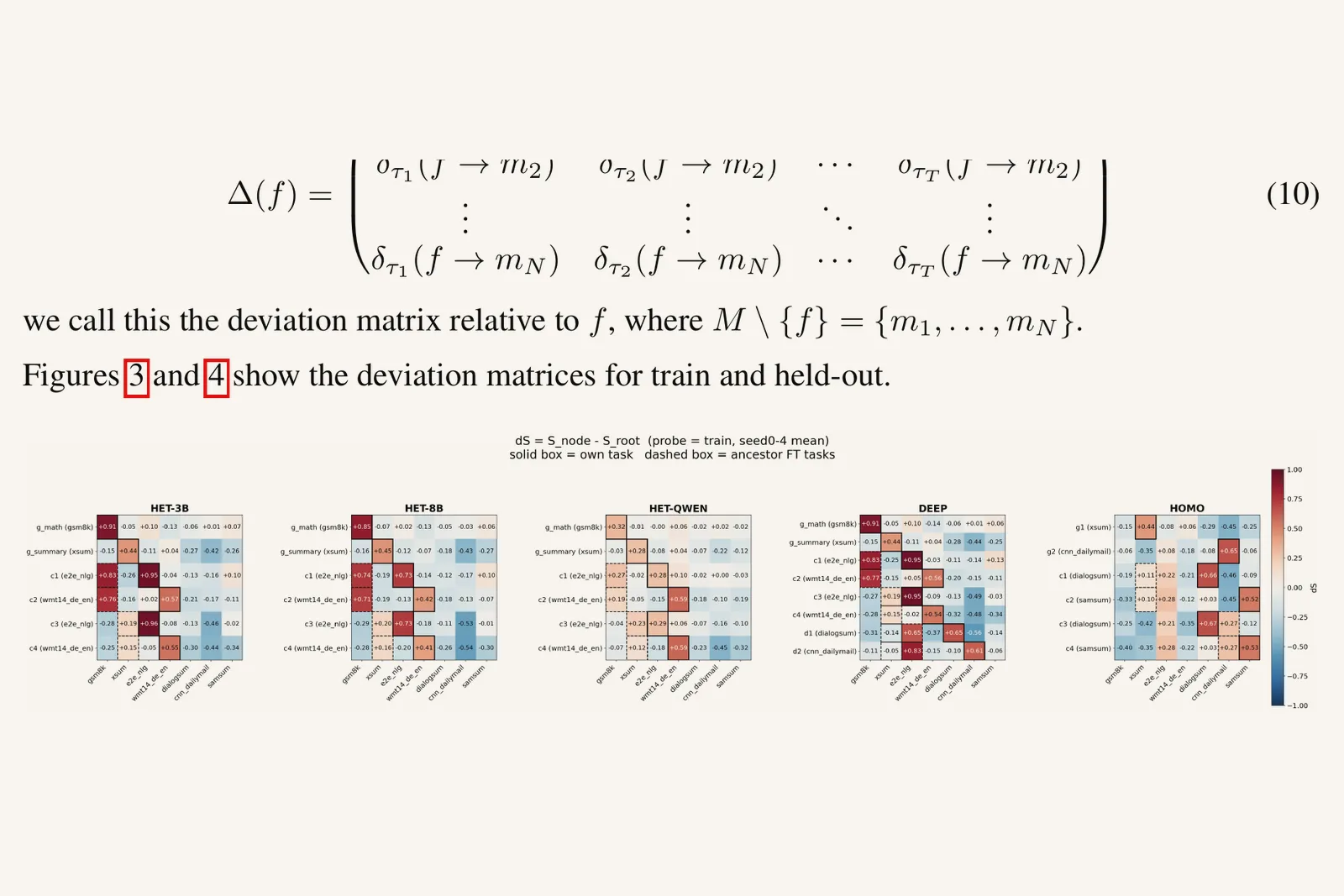
The method uses gray-box access: it observes teacher-forced log-likelihoods, which score supplied text, without inspecting model weights. The authors build on the observation that fine-tuning increases the likelihood of training examples and that descendants inherit this increase. They turn asymmetric differences between models into directed edge weights, then find the maximum spanning directed tree, including internal nodes, without hyperparameters or tree-structure constraints.[1]
The abstract reports five evaluation configurations comprising 25 model trees, three base models and seven tasks. TRACE-Edge reaches parent-match accuracy of 0.74 when probes use fine-tuning examples. The authors also report better average performance than an output-similarity baseline with held-out probes from the training distribution. Exactly optimizing the weighted tree does not establish that every inferred parent is correct; the reported accuracy remains the relevant empirical boundary.[1]
[1]: https://arxiv.org/abs/2611.08866
Lead photo: Sota Ogawa, Shojiro Yamabe, Daiki Nishiyama, Jun Sakuma · CC BY-SA 4.0.
Sources
Check or correct this page
Verification record
The digest below shows whether the text you are reading matches the published source. It does not show that the reporting is correct. The build computes it from this page's Markdown source and lists it in the site manifest.
d9dd8c556c235e46cff5ca26a9639e67480079bcda705f89f3a03cdb2a110314