On 18 November 2026, researchers submitted a preprint describing attacks on decentralized systems of AI agents and proposing a way to record and audit their actions. In the system described, independently operated agents decompose tasks, perform subtasks and delegate remaining work to peers; no single operator has a complete view of execution or authority over every agent.[1]
The authors report that, in their attacks, one malicious agent caused up to 100% task failure, increased token consumption by up to 7.7 times and runtime by up to 3.2 times, and extracted up to 94% of relevant prior tasks from benign agents. These are the authors’ reported maxima, not expected results for every deployment.[1]
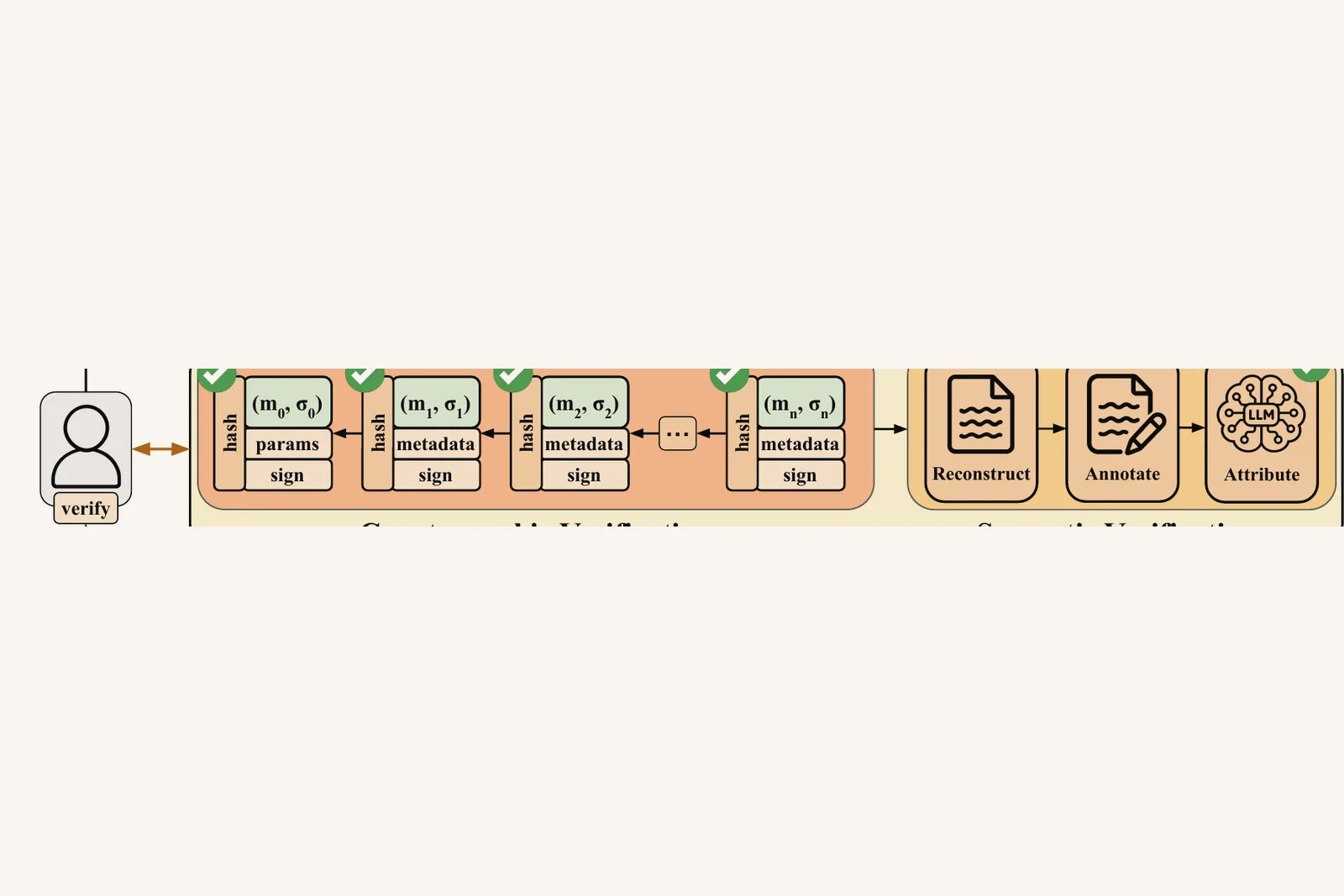
The proposed defense combines a cryptographic protocol for an execution trace with an auditor that analyzes traces to detect and attribute malicious behavior. The authors claim that the protocol produces a verified trace of every system action. They report that, in an evaluation on HiddenBench using gpt-6.1-sol and Qwen3.8-27B-FP8, the auditor detected and correctly attributed 98% of attacks, including attacks that complied with the protocol, while the protocol added negligible latency. The abstract does not establish those results for other systems or configurations.[1]
Lead photo: Matthew D. Laws, Maria Lazou, Alina Oprea, Cristina Nita-Rotaru · CC BY 4.0.
Sources
Check or correct this page
Verification record
The digest below shows whether the text you are reading matches the published source. It does not show that the reporting is correct. The build computes it from this page's Markdown source and lists it in the site manifest.
6b47224254ed2d0ee3e63d12af3698f06deca2c26e2a746d21515374bceeb3ab