Maisha Maliha, Vishal Pramanik and Sumit Kumar Jha proposed Agent Trajectory Control (ATC) in an arXiv submission dated 3 November 2026. The method checks whether an agent’s proposed message exceeds its assigned authority before admitting it to a shared conversation, according to the saved abstract. The listing identifies version v1 and says the paper was accepted at EMNLP 2026.[1]
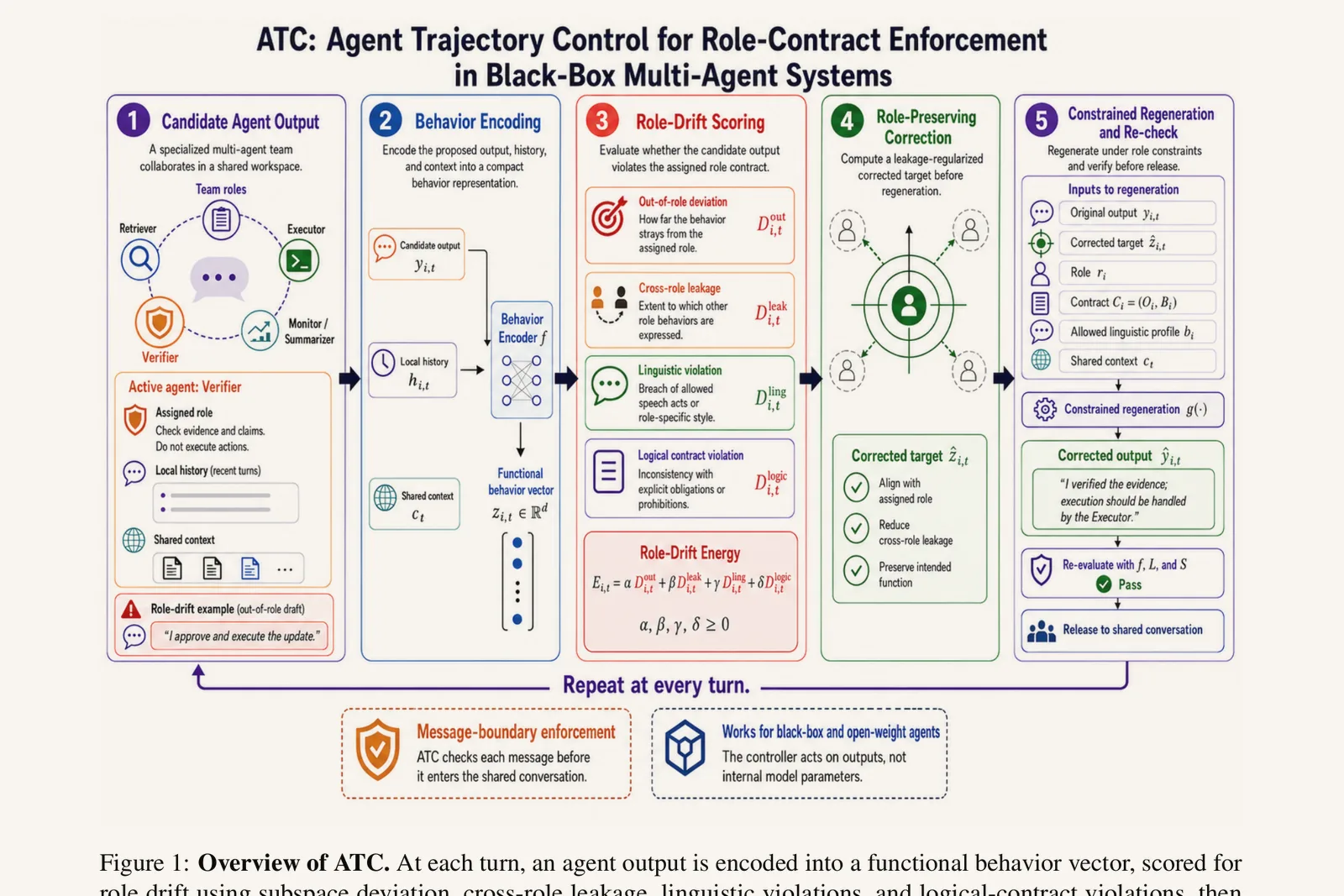
The authors define role drift as a turn-level breach of an agent’s role contract. Examples include a verifier beginning to plan, a retriever asserting unsupported conclusions, or an executor changing state without approval. ATC makes role authority explicit, then scores proposed outputs for out-of-role deviation, leakage into other roles’ functions, impermissible speech acts and logical contract breaches. It computes a leakage-regularized target to constrain regeneration and checks the revised message again before admission. The authors say this message-level approach accommodates agents whose internal representations are unavailable.[1]
The abstract reports better task performance and role consistency, with lower role-drift energy, against baselines covering prompting, memory, workflow control and activation editing. It says the largest gains occur under explicit role-confusion stress tests and in larger, more diverse teams. The saved abstract supplies no numerical results or experimental configurations, so these remain author-reported findings.[1]
[1]: https://arxiv.org/abs/2611.04321
Lead photo: Maisha Maliha, Vishal Pramanik, Sumit Kumar Jha · CC BY 4.0.
Sources
Check or correct this page
Verification record
The digest below shows whether the text you are reading matches the published source. It does not show that the reporting is correct. The build computes it from this page's Markdown source and lists it in the site manifest.
9999fc00259f85e8fb9e5e13869a03cdf48a75e7e090e07f6ac449f62066ab7c