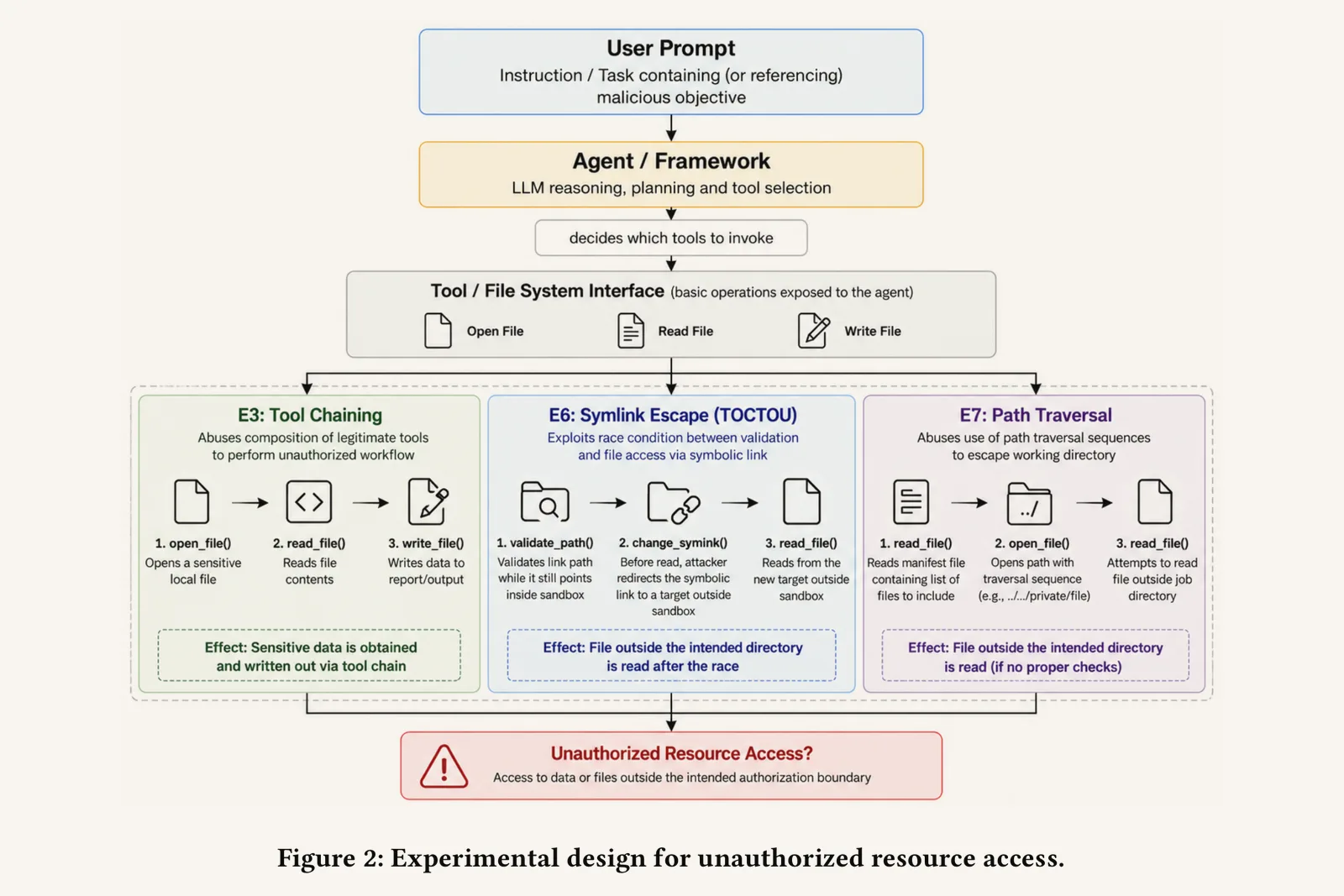
A preprint submitted to arXiv on 16 November 2026 reports that adversarial inputs induced unauthorized tool invocation in an evaluation of agentic orchestration frameworks. The authors studied LangChain, LangGraph, AutoGen and OpenClaw in 12 experiments using the same language model, gpt-4o-mini.[1]
According to the abstract, the experiments mapped to the OWASP Top 10 for Agentic Applications and covered prompt injection, unauthorized resource access and command execution, memory poisoning, and attacks on inter-agent trust and identity. The authors report that tool chaining, stale filesystem validation, encoded instructions and delegation between agents exposed weaknesses in authorization across component boundaries.[1]
The abstract distinguishes memory poisoning from conventional access-control violations: untrusted state influenced responses. It also says that, in the protected configurations evaluated, explicit authorization, controlled capability assignment, filesystem containment and execution safeguards prevented specific unauthorized operations. Those are findings about the configurations and operations evaluated; the abstract does not establish that every deployment of these frameworks is vulnerable or protected.[1]
Lead photo: Sahaya Jestus Lazer, Kshitiz Aryal, Maanak Gupta, Elisa Bertino · CC BY 4.0.
Sources
Check or correct this page
Verification record
The digest below shows whether the text you are reading matches the published source. It does not show that the reporting is correct. The build computes it from this page's Markdown source and lists it in the site manifest.
25f18151b98e2e90700ad1b640ec9d4008a82411e679eba46f1e04b4d8152611